Join us in shaping the future of espresso innovation
Share your product ideas and market needs
Participate in prototype testing and optimization
Co-develop products with stronger market competitiveness


A thermoblock heats water as it moves through a compact heating path, while a boiler heats and holds water in a dedicated vessel. A thermoblock may support fast readiness and efficient on-demand heating; a boiler may provide greater stored heat and steam capacity. The better choice depends on the machine design, menu, demand, and maintenance plan.
For coffee equipment buyers, distributors, and operators, the heating system should be judged together with the pump, water path, controls, brew group, steam circuit, and service design. Two machines using the same broad category can therefore deliver different workflows.
Quick answer: choose a thermoblock when the application values compact design, on-demand heating, and a focused drink workflow; consider a boiler when the operation needs stored hot water, stronger steam availability, or sustained multi-drink service. Always compare the complete system and documented use case, not the heater name alone.
This guide is part of the How Coffee Machines Work topic cluster. For broader equipment selection, see Coffee Machine Buying Guides. For practical cleaning and service planning, visit Coffee Machine Maintenance & Troubleshooting.
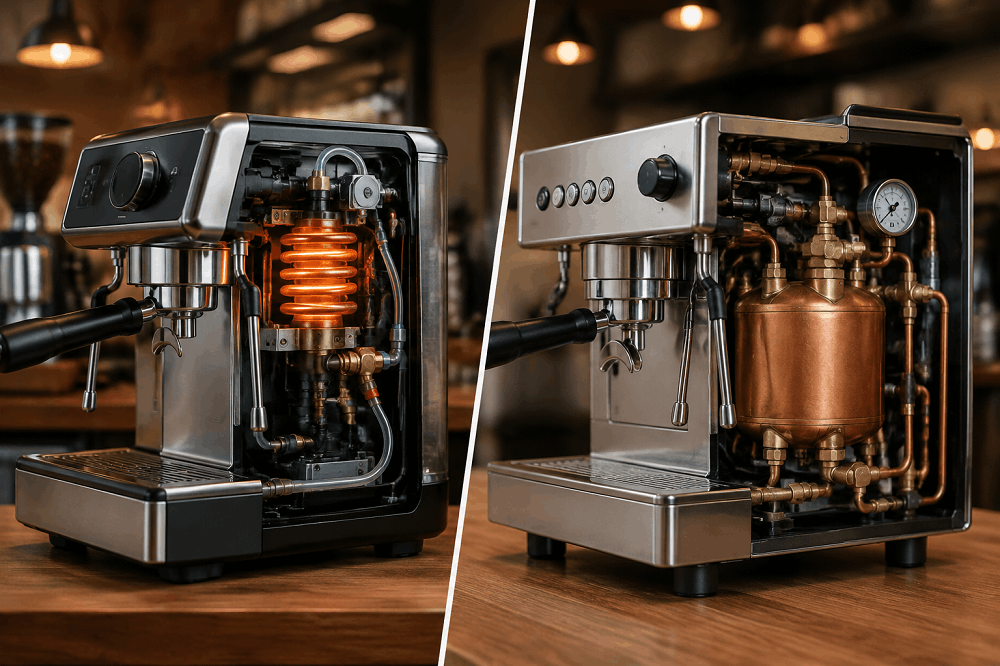
A thermoblock is a compact heating assembly designed to heat water as it passes through a controlled path. Unlike a storage boiler, it does not depend on holding a large volume of brew water at operating temperature. Construction varies: some systems use a heated metal block with an internal water channel, while related designs use a thermocoil or another flow-through arrangement.
When a drink cycle starts, water moves through the heating path and into the brewing circuit. Sensors and electronic controls may manage the process, but temperature performance still depends on flow rate, sensor position, control logic, group-head temperature, and water-path condition.
A boiler is a vessel that heats and stores water or produces steam for a defined function. Coffee machines may use one boiler for several duties, a heat-exchanger arrangement, or separate brew and steam boilers. These designs should not be treated as identical.
Stored heat can support repeated brewing or steaming. The trade-off is that the boiler, insulation, controls, and water system must be heated and maintained. Warm-up, energy use, recovery, and service needs depend on the complete boiler architecture, not on the word “boiler” alone.
The table shows common design tendencies, not a guarantee for every machine. Review product specifications and test conditions before making a commercial decision.
| Comparison point | Thermoblock | Boiler |
|---|---|---|
| Heating approach | Heats water through a compact flow-through path or related on-demand arrangement. | Heats and stores water or produces steam in a dedicated vessel or vessels. |
| Readiness | Can provide a fast on-demand heating workflow, depending on the design and control system. | May require more time to heat the stored volume, depending on boiler size and operating state. |
| Steam availability | Depends on whether the machine has a separate steam heater or another dedicated milk system. | Often suited to stored steam production, but capacity and recovery depend on the specific design. |
| Peak workflow | Can suit focused or moderate workflows; sustained demand depends on heating power, flow, and recovery design. | Can support sustained brewing or steaming when the boiler arrangement and rated use match the demand. |
| Temperature behaviour | Depends strongly on flow rate, sensors, controls, thermal mass, and water path design. | Depends on boiler configuration, temperature control, heat recovery, group design, and operating pattern. |
| Physical format | Often enables a compact internal layout, although the complete machine may still need pumps, valves, controls, and cooling components. | Requires space for one or more vessels, insulation, fittings, and related safety and service components. |
| Maintenance focus | Water channels, sensors, valves, outlets, and scale management remain important. | Water-contact surfaces, valves, safety components, scale management, and boiler-related service access remain important. |
A thermoblock can suit machines that heat water close to the time of brewing, which may reduce the need to keep a larger volume hot during quiet periods. Readiness still depends on the heater, controls, water volume, ambient conditions, and drink cycle. A boiler may take longer to reach operating state, then provide stored heat for its assigned functions.
Temperature stability is not decided by thermoblock versus boiler alone. Brewing temperature is affected by the water path, sensors, controls, flow, brew group, thermal mass, recipe, and maintenance. Either architecture can perform consistently when correctly designed and used within its intended workflow.
Milk drinks add a separate demand. Some compact machines use an independent heater for steam, while others use an automatic milk system. Boiler machines may offer stored steam, but the result depends on boiler size, steam circuit, recovery, wand design, and operator technique. Verify the actual milk workflow for the model.
Peak demand is a system question. Either architecture can support repeated drinks when heating power, controls, recovery, and capacity match the workload. Tell the supplier the drinks per peak period, proportion of milk drinks, water source, serving sequence, and available time between orders.
A flow-through thermoblock may reduce the need to keep a larger stored volume hot during idle periods, but energy use also depends on power, insulation, standby controls, heating cycles, steam production, and total operating time. A boiler may use more energy in one application while supporting a more efficient workflow in another.
Both designs need water care. Mineral deposits can form in heated paths, valves, outlets, and boilers. Follow the exact cleaning, descaling, and water-treatment instructions. Service access, replacement parts, documentation, and local support may matter more to long-term operation than the heating label.
For operational guidance, see coffee machine maintenance and troubleshooting.
Start with the application. The examples below are decision prompts, not universal product recommendations.
| Application pattern | What to investigate | Why the distinction matters |
|---|---|---|
| Office or meeting room | Ease of use, readiness, drink range, noise, counter space, cleaning responsibility, and expected peak demand. | A compact on-demand system may fit the workflow, but the chosen model must still handle the actual drink menu. |
| Hotel guest or breakfast area | Self-service simplicity, refill and waste capacity, morning demand, milk options, hygiene, and service access. | A machine must remain understandable and manageable when many users share the equipment. |
| Cafe or barista station | Steam performance, recovery, brew-group behaviour, operator control, recipe consistency, and service volume. | The machine needs to match the preparation method and the pace of the beverage menu. |
| Restaurant or foodservice area | Menu breadth, service peaks, staff training, water arrangement, cleaning time, and after-sales response. | The preferred design is the one that supports the whole service routine, not just the first cup. |
| Distributor product range | Target applications, technical documentation, spare parts, training, warranty process, and market-specific support. | A clear heating-system explanation helps match models to customers without making unsupported performance promises. |
Neither is universally better. A thermoblock may suit compact, on-demand, or focused drink workflows. A boiler may suit operations that need stored heat or repeated steam service. Compare the complete machine against the menu, peak demand, installation, and maintenance plan.
It can, when the complete system is designed and controlled for the intended brewing process. Espresso quality also depends on the coffee, grinder, dose, water, recipe, brew group, operator workflow, and cleaning condition. The heater type alone does not determine the result.
A boiler can provide stored steam, but suitability depends on the boiler arrangement and its rated workflow. Some thermoblock machines also use a separate steam heater or an automatic milk system. Confirm steam availability, recovery, milk controls, and cleaning requirements for the specific model.
A thermoblock may reduce heating during idle periods in some use cases, but energy use depends on power, insulation, standby controls, heating cycles, steam demand, and total operating time. Request comparable test conditions before making a supplier-to-supplier energy claim.
Ease of maintenance depends on access, instructions, water quality, cleaning prompts, replaceable parts, and local service support. Both systems need water care and routine cleaning. Ask for the maintenance schedule and service procedure for the exact model.
Ask which heating architecture is used, what functions each heater supports, how the machine performs under the intended workload, what water and power requirements apply, how cleaning and descaling work, which parts are serviceable, and what support is available in your market. Ask the supplier to separate verified specifications from general design tendencies.
Thermoblock and boiler systems solve the heating problem in different ways. A thermoblock focuses on compact, controlled, on-demand heating, while a boiler stores heated water or steam for the functions assigned to it. Neither label is enough to predict drink quality, speed, energy use, or commercial suitability without understanding the complete machine.
For a sound purchasing decision, begin with the menu and service pattern. Then verify the machine architecture, peak workflow, installation conditions, cleaning process, documented specifications, and after-sales support. This application-first approach helps importers, distributors, and operators choose equipment they can explain, operate, and support in the real market.
Explore Empstorm’s espresso coffee machine range and semi-automatic espresso machines, then compare the requirements of your target applications. For distributor discussions, send us your market, menu, expected demand, installation conditions, and support requirements.