Join us in shaping the future of espresso innovation
Share your product ideas and market needs
Participate in prototype testing and optimization
Co-develop products with stronger market competitiveness

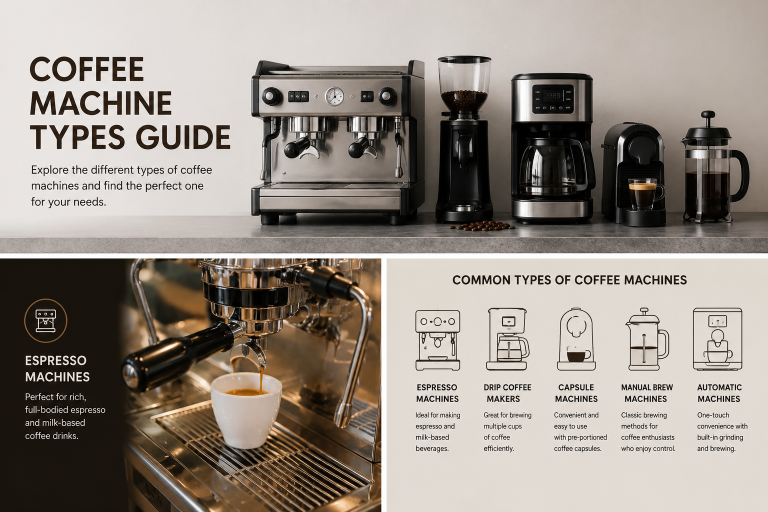
If you’re new to espresso machines, start with our Ultimate Guide to Coffee Machine Types.
Understanding coffee maker types enables precise selection for cafes, hotels, and home prosumers. Machines differ in brewing method, capacity, and ROI, directly affecting workflow efficiency and beverage quality.
Coffee makers vary from manual espresso machines to fully automated bean-to-cup systems. Each type offers distinct performance metrics, thermal stability, and operational complexity. Choosing the right equipment impacts beverage consistency, labor costs, and customer satisfaction.
The coffee equipment market is dominated by five main types: manual espresso, semi-automatic espresso, fully automatic espresso, drip coffee brewers, and bean-to-cup machines. Each type varies in automation, throughput, and maintenance requirements.
| Type | Automation Level | Capacity | Maintenance | Typical Use Case |
|---|---|---|---|---|
| Manual Espresso | Manual | 1–2 cups/session | High skill, regular calibration | Specialty cafes, prosumer homes |
| Semi-Automatic Espresso | Semi-Automatic | 2–4 cups/min | Moderate; periodic descaling | Cafes with trained baristas |
| Fully Automatic Espresso | Automatic | 3–6 cups/min | Low; built-in cleaning | High-volume cafes, offices |
| Drip Coffee Brewer | Semi/Automatic | 8–12 cups/batch | Low; filter replacement | Restaurants, catering |
| Bean-to-Cup | Fully Automatic | 1–8 cups/min | Low; auto-clean, grinder maintenance | High-volume, labor-conscious cafes |
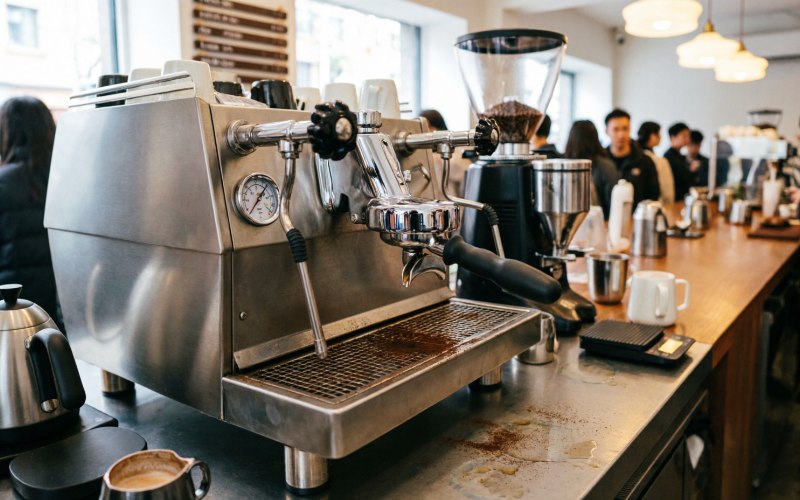
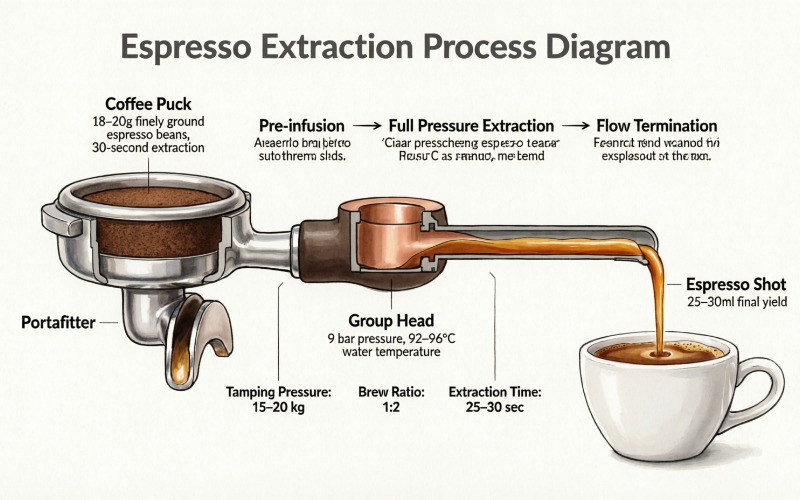
Espresso machines operate by forcing hot water at 9–15 bar pressure through finely ground coffee. Semi-automatic and fully automatic machines use PID (Proportional-Integral-Derivative) controllers to maintain temperature within ±1°C. Extraction time averages 25–30 seconds per shot, delivering 25–30 mL of espresso with optimal crema formation.
Drip coffee brewers heat water to 92–96°C and deliver it evenly across ground coffee using showerhead dispersion. Batch sizes range from 8–12 cups. Thermal carafes maintain 85–90°C for 30–45 minutes. They are highly efficient, with brew consistency reaching ±2°C temperature variation across cups.
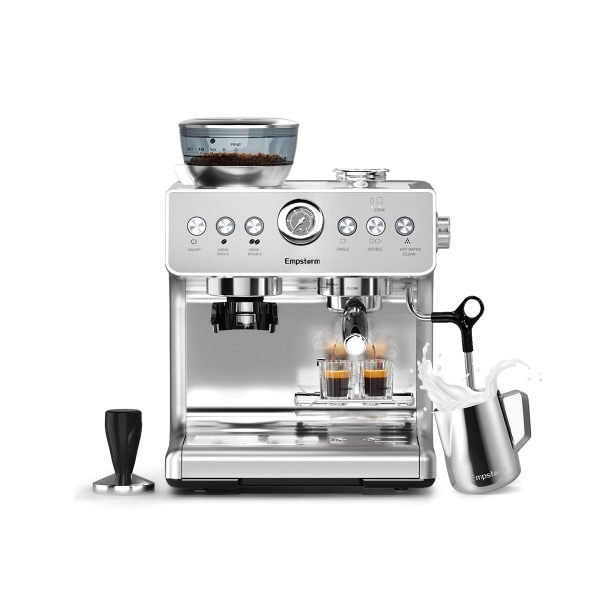
Bean-to-cup machines integrate grinder, tamping, and automated brewing into one workflow. They reduce labor by 40–50% and maintain water temperature within ±1.5°C using dual boilers or heat-exchange systems. Throughput ranges from 1 to 8 cups per minute depending on hopper size and grinder RPM.
| Type | Entry Price ($) | High-End Price ($) | Maintenance Cost/Year ($) | ROI Considerations |
|---|---|---|---|---|
| Manual Espresso | 500 | 3,000 | 300 | High skill, low automation |
| Semi-Automatic | 1,500 | 6,000 | 400 | Moderate volume efficiency |
| Fully Automatic | 3,000 | 15,000 | 500 | High throughput, labor saving |
| Drip Brewer | 150 | 1,500 | 100 | Batch service, low skill |
| Bean-to-Cup | 2,500 | 20,000 | 600 | Full automation, high-volume ROI |
Cafes with trained baristas benefit from semi-automatic machines, while high-volume chains favor fully automatic or bean-to-cup systems. Drip brewers are ideal for offices, catering, and breakfast service. Prosumer homes seeking craft control often prefer manual espresso or hybrid semi-automatic machines.
Maintain PID calibration for temperature stability, regularly descale boilers to prevent scale accumulation, and use freshly ground beans to optimize extraction. Dual boilers improve throughput and allow simultaneous steaming and brewing. Water hardness should be below 100 ppm to reduce boiler wear.
Understanding coffee maker types ensures operational efficiency, optimal ROI, and beverage quality across cafes, hotels, and prosumer home settings.