Join us in shaping the future of espresso innovation
Share your product ideas and market needs
Participate in prototype testing and optimization
Co-develop products with stronger market competitiveness


Maximize ROI and consistency. A technical guide for system integrators on selecting commercial espresso equipment with PID control and multi-boiler tech.
This article is part of our Coffee Machine Buying Guides series. For a complete overview, visit our Coffee Machine Knowledge.
Selecting the optimal hydraulic platform for a commercial coffee program is not merely a matter of aesthetics or brand preference. For B2B system integrators and equipment wholesalers, the decision matrix must prioritize thermal thermodynamics, extraction consistency, and Total Cost of Ownership (TCO). A mismatch between machine specifications and operational throughput leads to thermal instability, inconsistent extraction yields, and ultimately, client dissatisfaction.
High-volume commercial environments require equipment capable of maintaining precise water temperature and pressure profiles under heavy load. Understanding the engineering nuances between heat exchange systems and multi-boiler architectures is critical for specifying the correct equipment. This guide provides a technical deep-dive into the specifications that matter most when you advise clients on commercial espresso machines.
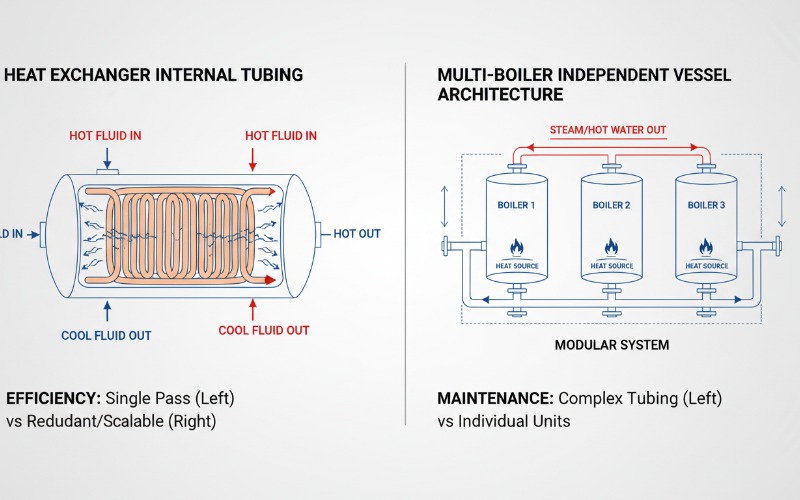
The boiler system is the engine of any espresso machine. Its primary function is to deliver water at a stable temperature and pressure. However, the method by which a machine achieves this varies significantly across equipment classes. For system integrators, distinguishing between legacy Heat Exchanger (HX) technology and modern Multi-Boiler systems is the first step in proper specification.
Heat Exchanger machines utilize a single large steam boiler with a copper tube passing through it for brew water. While energy-efficient and cost-effective, HX systems rely on a cooling flush to regulate brew temperature. This introduces a variable that is difficult to control in high-volume settings. The cooling flush requires skilled barista intervention, making it less suitable for environments demanding automated consistency. Under continuous load, the thermal recovery time of the heat exchanger tube may lag, causing a drop in extraction temperature and sour espresso shots.
For specialty coffee applications, Multi-Boiler Stability is the gold standard. These systems dedicate independent boilers for steam and brewing. The brew boiler is often significantly smaller, allowing for rapid heating and precise temperature management. By decoupling the steam generation from the coffee extraction water, the machine can produce endless steam power without influencing the brew temperature. This architecture allows high-volume cafes to steam milk and pull shots simultaneously without thermal cross-talk.
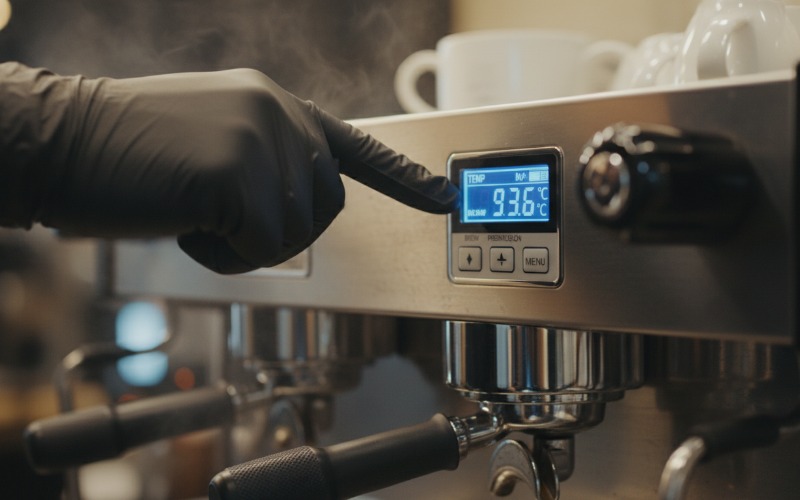
Temperature stability is arguably the most critical variable in espresso extraction. A variance of just 1°C can alter the solubility of coffee compounds, changing a sweet, balanced shot into an astringent failure. This is where PID Control (Proportional-Integral-Derivative) becomes non-negotiable for professional setups.
Legacy machines utilized mechanical pressurestats, which operate on a wide deadband—often resulting in a temperature swing of 2°C to 4°C as the heating element cycles on and off. A PID controller utilizes a sophisticated algorithm to continuously monitor water temperature and pulse the heating element effectively. This minimizes the delta between the set point and the actual temperature.
When consulting on high-end installations, ensure the machine features individual PID controllers for each group boiler. This allows the operator to set different temperatures for different roast profiles—for example, a lower temperature for a dark roast to reduce bitterness, and a higher temperature for a light roast to maximize acidity.
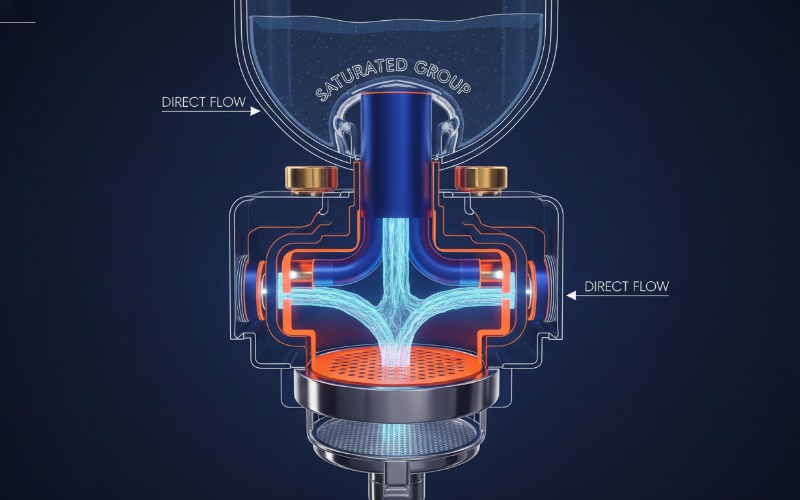
Beyond the boiler, the path water travels to the coffee puck must remain thermally stable. Traditional E61 group heads rely on a thermosyphon loop to keep the heavy brass head hot. While effective, they can still suffer from heat loss if the machine sits idle or is exposed to drafts.
Saturated Group Heads represent the pinnacle of engineering in this regard. In this design, the group head is hollow and directly connected to the brew boiler, meaning it is constantly filled with hot water from the boiler itself. The group head essentially becomes an extension of the boiler. This design eliminates temperature loss between the boiler and the coffee puck, ensuring that the water hitting the coffee is exactly the temperature displayed on the PID controller. For system integrators looking to guarantee consistency for clients, machines with saturated groups offer the highest reliability.
In a bustling café environment, workflow efficiency translates directly to revenue. Manual brewing (starting and stopping the shot by eye) introduces human error and inconsistency. Volumetric Dosing utilizes flow meters to measure the exact volume of water passing through the group head. Once the programmed volume is reached, the pump cuts strictly.
Volumetrics allow baristas to multitask—steaming milk or engaging with customers while the shot pulls. For B2B buyers, recommending machines with high-precision flow meters reduces the training barrier for staff and ensures that the flavor profile remains consistent regardless of who is operating the machine. When paired with high-quality coffee grinders that offer gravimetric or timed dosing, Volumetric Dosing creates a closed-loop system of consistency.
Use the following comparison to determine the correct equipment class for your client’s specific volume and quality requirements.
| Feature | Heat Exchanger (HX) | Dual Boiler | Independent Multi-Boiler |
|---|---|---|---|
| Thermal Stability | Moderate (Requires Flushing) | High (PID Controlled) | Extreme (Individual PIDs) |
| Steam Capacity | Shared Power | Dedicated Boiler | Dedicated High-Capacity Boiler |
| Temp Adjustment | Pressurestat (Imprecise) | Digital PID (Global) | Digital PID (Per Group) |
| Group Head Type | E61 Thermosyphon | Ring / Saturated | Saturated Group Heads |
| Ideal Volume | Low to Medium | Medium to High | High to Extreme |
| TCO & Maintenance | Lower Initial, Higher Maint | Balanced | High Initial, Low Component Stress |
A common failure point in equipment supply is neglecting the physical infrastructure of the installation site. As a system integrator, you must audit the client’s facility for electrical and hydraulic compatibility before finalizing the machine choice.
High-performance multi-boiler machines often require significant power draw to heat cold water rapidly. While some 2-group machines operate on single-phase 220V/30A circuits, larger 3 or 4-group units may require 3-phase power. Verify the amperage available at the breaker panel. Installing a machine that is underpowered leads to slow recovery times and inability to steam milk during rush hours.
Water quality is a dual-threat issue: it affects flavor extraction and equipment longevity. Scale accumulation is the leading cause of solenoid valve failure and boiler inefficiency. A reverse osmosis (RO) system with remineralization is often required to protect the investment, particularly for machines with small restrictors like Saturated Group Heads. Furthermore, verify that the drainage drop is sufficient; commercial espresso machines rely on gravity for drainage, and a shallow drop can lead to backups and hygiene issues.
When answering how to choose the right coffee machine, the sticker price is only one component. The Total Cost of Ownership includes energy consumption, preventative maintenance, and the cost of downtime. Machines with advanced energy-saving modes (Eco-mode) can lower electricity bills significantly by powering down unused boilers during off-peak hours. Additionally, consider the availability of OEM parts. Proprietary components that must be shipped internationally can result in extended downtime. Choosing a brand with a strong local distributor network ensures that technical support is available when critical failures occur.
A dual boiler system uses one boiler for steam and one for brewing water that is shared across all group heads. A multi-boiler system features a dedicated steam boiler plus independent boilers for each individual group head. This allows for specific temperature profiling per group and ensures that heavy use on one group does not affect the temperature stability of the others.