Join us in shaping the future of espresso innovation
Share your product ideas and market needs
Participate in prototype testing and optimization
Co-develop products with stronger market competitiveness


The landscape of single-serve coffee extraction has evolved significantly beyond the domestic appliance market. For B2B system integrators and commercial equipment distributors, understanding the engineering constraints and hydraulic architectures of capsule coffee machine systems is critical for selecting reliable OEM partners. Modern capsule technology now rivals traditional espresso methods in consistency, utilizing sophisticated PID control, precise flowmetry, and advanced polymer engineering to handle high-volume commercial environments.
This technical analysis dissects the internal mechanisms of professional capsule equipment, focusing on hydraulic integrity, thermal mass management, and the comparative advantages of closed versus open standards. We will explore how these variables impact Total Cost of Ownership (TCO) and extraction quality in Office Coffee Service (OCS) and HoReCa sectors.
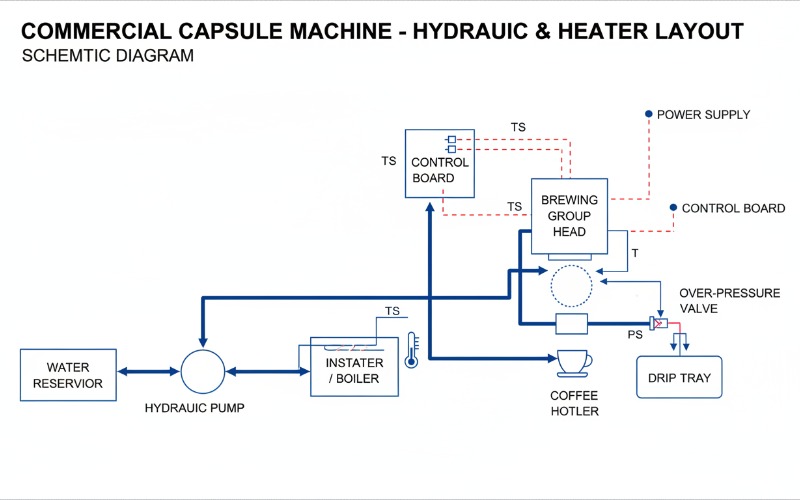
The fundamental differentiator between consumer-grade and commercial capsule machines lies in the hydraulic circuit. While domestic units rely on simple vibration pumps with unregulated flow, commercial systems integrate robust fluid dynamics to ensure repeatability.
Most espresso-based capsule systems (e.g., Nespresso Original, Lavazza Blue) operate at a theoretical maximum of 19 to 20 bars. However, the effective extraction pressure at the capsule interface typically stabilizes between 9 and 12 bars. Commercial integrators must look for pumps equipped with Over-Pressure Valves (OPV) that divert excess water back to the tank or drip tray. This bypass mechanism prevents channel rupturing within the coffee bed, a common failure point in lower-end hardware.
In high-volume OCS environments, pump duty cycles are paramount. Standard vibration pumps require a rest period (e.g., 1 minute on, 1 minute off) to prevent thermal overload. Advanced commercial capsule units often employ dual-pump systems or heavy-duty solenoid valves to manage higher throughput without component fatigue.
Achieving thermal stability in compact footprints requires engineering ingenuity. Unlike traditional commercial espresso machines with large brass boilers, capsule machines typically utilize on-demand heating elements. The challenge for system integrators is identifying machines that minimize “first-cup” temperature drop.
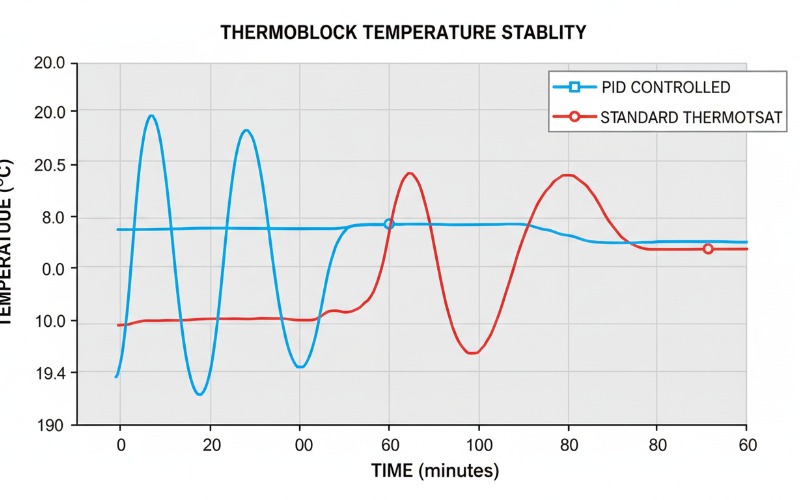
Thermoblocks are cast aluminum or brass blocks with a water pipe molded inside. While cost-effective, they often suffer from inconsistent heat transfer and scale accumulation. Thermocoils, conversely, feature a continuous stainless steel tube encased in a heating element. This design offers superior structural integrity and resistance to calcification.
For professional integration, machines utilizing Proportional-Integral-Derivative (PID) controllers are mandatory. PID logic monitors the heating element hundreds of times per second, pulsing power to maintain the target temperature within +/- 1°C. This precision ensures that the volatile aromatic compounds in the coffee capsule are extracted correctly, avoiding the sourness associated with under-temperature water.
The mechanics of the brewing chamber determine the machine’s compatibility and longevity. The brewing unit is responsible for loading the capsule, creating a hydraulic seal, piercing the casing, and ejecting the spent pod.
The material composition of the piercing blades is a critical specification. Manufacturers often choose between hardened stainless steel and high-performance polymers like PEEK (Polyether ether ketone). While PEEK offers excellent chemical resistance and thermal insulation, stainless steel blades are preferred for commercial environments handling aluminum capsules. Improper material pairing can lead to blade dulling, resulting in incomplete piercing and hydraulic failure.
System integrators must choose a platform that aligns with their client’s logistical capabilities. The choice between an open system (compatible with third-party fillers) and a closed system (proprietary lockdown) impacts supply chain flexibility.
| System Standard | Typical Pressure | Capsule Material | Primary Application | Open/Closed Architecture |
|---|---|---|---|---|
| Nespresso Original Compatible | 19 Bar | Aluminum / Plastic | Espresso / Lungo | Open (High Variety) |
| Lavazza Blue | 15-20 Bar | Plastic (PP) | Vending / OCS | Semi-Closed |
| K-Cup (Keurig) | Low Pressure | Plastic / Filter | Filter Coffee | Open (Regional) |
| Nespresso Vertuo | Centrifusion | Aluminum | Large Cup / Espresso | Closed (Proprietary) |
| ESE Pod (44mm) | 9-15 Bar | Paper | Espresso | Open Standard |
Consistency is the hallmark of commercial coffee service. To achieve this, high-end capsule machines utilize turbine flowmeters placed on the cold water side of the hydraulic circuit. As water passes through the impeller, Hall effect sensors generate electronic pulses corresponding to specific volumes.
This method is superior to time-based dosing, which is susceptible to variations in grind size or pump degradation. For a system integrator, ensuring the machine utilizes true volumetric flowmetry allows for precise programmable buttons (e.g., 40ml Espresso, 110ml Lungo) that remain accurate regardless of minor fluctuations in grid power or water pressure.
The shift toward sustainable consumables presents new engineering challenges. Compostable capsules often utilize biopolymers that react differently to heat and pressure compared to aluminum or PP. Commercial machines must be engineered with wider tolerances in the ejection mechanism to prevent biopolymer capsules from jamming after expansion.
Furthermore, Energy Mode compliance (ErP directives in Europe) requires machines to enter standby modes rapidly. High-quality commercial units utilize insulated boilers and efficient flash-heating elements to comply with regulations without sacrificing the “ready-to-brew” speed demanded by office environments.
For more insights on traditional systems, review our guides on Commercial Espresso Machines and precision Coffee Grinders.
The following technical inquiries address common concerns for distributors and technicians regarding capsule machine architecture.
While rotary pumps offer quieter operation and longer lifespans, vibration pumps are standard in capsule machines due to their ability to build pressure rapidly in a compact space. However, for commercial applications, the vibration pump must be rated for higher duty cycles to prevent thermal cut-off during rush periods.
If you’re new to espresso machines, start with our Ultimate Guide to Coffee Machine Types.