Join us in shaping the future of espresso innovation
Share your product ideas and market needs
Participate in prototype testing and optimization
Co-develop products with stronger market competitiveness

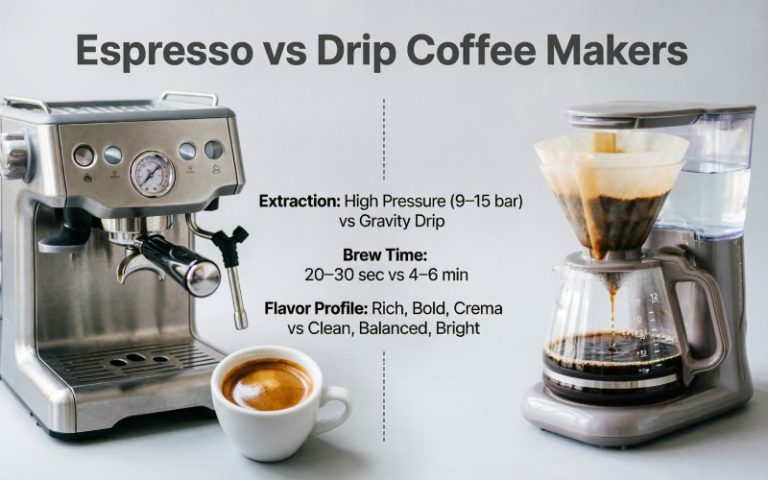
For B2B system integrators and coffee equipment distributors, distinguishing between high-end consumer drip coffee makers and commercial batch brewers is fundamental to client satisfaction. While the basic operational principle—gravity-fed hot water passing through ground coffee—remains identical, the engineering architectures diverge significantly. In a professional setting, consistency, recovery time, and thermal precision are not luxuries but operational requirements.
The specification of brewing equipment impacts workflow efficiency, utility requirements, and ultimately the cup profile served to the end customer. This analysis dissects the technical disparities between residential platforms and commercial batch brewing systems, focusing on thermodynamics, hydraulic integration, and control logic.
The primary failure point of residential drip coffee makers in a commercial application is thermal instability. The Specialty Coffee Association (SCA) mandates a brewing temperature range of 92°C to 96°C (197.6°F to 204.8°F). Maintaining this window throughout the entire saturation phase is critical for proper solubilization of coffee compounds.
Residential units typically employ a single-phase heating element ranging from 800W to 1400W. These elements function on a “flash heating” principle, where water is heated on demand as it moves from the reservoir to the spray head. This method frequently results in a temperature curve that starts low, peaks briefly, and fluctuates wildly depending on flow rate.
Commercial batch brewers integrate elements ranging from 3000W to 6000W, often requiring 220V or hardwired single-phase connections. This massive power overhead allows the system to heat large volumes of incoming cold water (often 15°C from the mains) to brewing temperature instantly without the thermal sag observed in consumer units.
Advanced commercial systems utilize Proportional-Integral-Derivative (PID) controllers rather than simple bimetallic thermostats. A PID controller continuously monitors the boiler temperature and pulses the heating element to maintain stability within ±0.5°C. This precision ensures that the extraction yield remains consistent from the first batch of the day to the peak rush hour service.
Fluid dynamics play a crucial role in extraction uniformity. In a residential drip maker, water is often dispensed through a narrow showerhead with limited coverage, leading to channeling. Channeling occurs when water finds the path of least resistance through the coffee bed, over-extracting some grounds while leaving others dry.
Commercial batch brewers feature large-diameter spray heads engineered to match the geometry of the brew basket. This design ensures total saturation of the coffee bed within seconds of cycle initiation. Furthermore, many commercial units utilize controlled turbulence—agitation of the grounds caused by the force of the water spray—to ensure even wetting and maximize total dissolved solids (TDS).
Integrators must note that commercial systems often include programmable flow rates. By using variable speed pumps or precise solenoid valves, these machines can alter the contact time between water and coffee. This capability allows operators to dial in recipes for different roast profiles, a feature entirely absent in standard residential equipment.
For B2B installations, the method of water delivery dictates workflow efficiency. Residential machines rely on manual reservoir refilling, which introduces human error and slows down service during peak hours.
Commercial brewers are plumbed directly into the facility’s water supply. This requires the installation of pressure regulators and filtration systems to protect the machine from scale and sediment. The direct connection allows for auto-refill logic, where the boiler replenishes immediately after a brew cycle is initiated. This capability is essential for “back-to-back” brewing.
Recovery rate is the defining metric for high-volume environments. It calculates how quickly the machine can heat incoming water to brew temperature. A commercial brewer with a 4000W element can produce upwards of 30 to 50 liters of coffee per hour. In contrast, a residential machine requires a cooling period between cycles to prevent overheating components, severely limiting hourly output.
| Specification | Residential Drip System | Commercial Batch Brewer |
|---|---|---|
| Heating Power | 800W – 1400W (110V) | 3000W – 6000W (220V/240V) |
| Temp Stability | Variable (±5°C fluctuations) | PID Controlled (±0.5°C to ±1°C) |
| Water Supply | Manual Reservoir | Direct Plumbed + Auto-Refill |
| Flow Control | Gravity/Check Valve | Solenoid/Pump Driven |
| Hourly Output | 2 – 4 Liters | 30 – 60 Liters |
| Material | Plastic / Thin Aluminum | 304 Stainless Steel / Copper |
Modern commercial equipment serves as an IoT node within the smart cafe ecosystem. Manufacturers now integrate advanced control boards that offer granular control over the brewing phases. This level of programmability is vital for businesses aiming to replicate a specific sensory profile across multiple locations.
Pulse brewing involves cycling the water flow on and off during the extraction. This technique allows for the coffee bed to degas (bloom) and prevents the basket from overflowing when using fresh, dark-roasted coffee. Additionally, commercial units often feature a “bypass” valve. This valve routes a percentage of hot water around the coffee bed directly into the server, allowing the operator to brew a concentrate and dilute it to the desired strength. This functionality provides control over both extraction yield and brew strength independently.
For system integrators, the ability to access diagnostic menus is invaluable. Commercial brewers track metrics such as total cycles, filter life, and error logs (e.g., fill timeout, sensor failure). Some advanced platforms support USB recipe transfer or Wi-Fi telemetry, enabling headquarters to update brew parameters across a fleet of machines remotely.
The physical construction of the equipment dictates its lifespan and ROI. Residential machines rely heavily on molded thermoplastics and thin-wall aluminum tubing. These materials degrade under constant thermal cycling, leading to leaks and component failure within 1-2 years of heavy use.
Commercial batch brewers are constructed using 304-grade stainless steel for chassis and boilers, with copper or Teflon plumbing lines. These materials resist corrosion and thermal fatigue. Furthermore, commercial units are modular; solenoid valves, heating elements, and control boards can be individually replaced. This serviceability ensures a machine lifespan of 7-10 years, drastically lowering the Total Cost of Ownership compared to replacing consumer units annually.
When consulting for a B2B client, recommending a commercial batch brewer is an investment in reliability. The initial capital expenditure is higher, but the operational stability, reduced downtime, and superior product quality justify the cost for any business serving more than 20 cups per day.
Commercial brewers use high-wattage heating elements (3000W+) to recover water temperature instantly between brew cycles. A 220V connection provides the necessary amperage to power these elements efficiently without overloading standard 110V circuits.
You may also find these guides helpful: