Join us in shaping the future of espresso innovation
Share your product ideas and market needs
Participate in prototype testing and optimization
Co-develop products with stronger market competitiveness

Analyze thermal stability, PID control, and ROI in Single vs Dual Boiler commercial espresso machines. Expert engineering guide
This article is part of our Coffee Machine Knowledge series. For a complete overview, visit our Coffee Maker Types guide.
Choosing between a single boiler and a dual boiler espresso machine affects more than taste. It changes drink speed, workflow, training needs, maintenance planning, and the total cost of ownership—especially for cafés, offices, hospitality projects, and distributors.
This guide breaks down how each system works, what buyers should expect, and which one fits your business model.
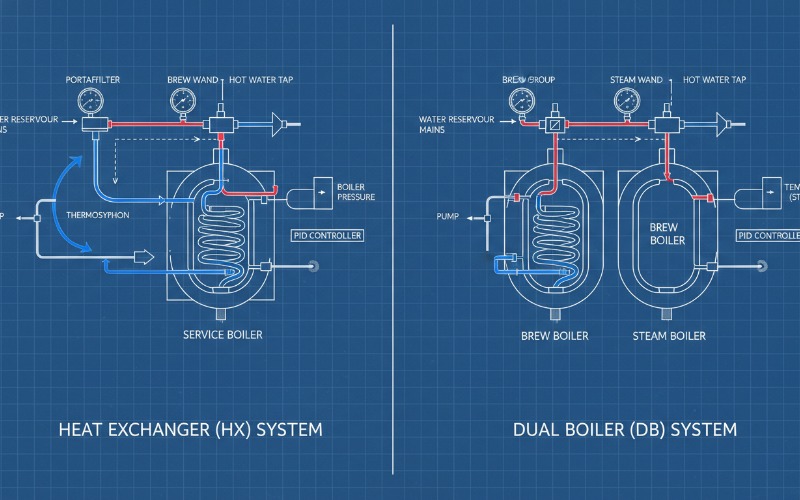
A single boiler espresso machine uses one boiler to handle both:
Because those two tasks need different temperatures, the machine must switch modes. That means waiting for the boiler to heat up for steam—or cool down for brewing—between steps.
A dual boiler espresso machine uses two separate boilers:
That separation allows simultaneous brewing and steaming, faster workflow, and more stable temperature control—especially useful when producing multiple milk drinks back-to-back.
| Feature | Single Boiler | Dual Boiler |
|---|---|---|
| Brew + steam at same time | ❌ No | ✅ Yes |
| Milk drink speed | Slower | Faster |
| Peak-hour workflow | Limited | Strong |
| Temperature stability | Good (depends on design) | Typically better, more consistent |
| Complexity | Lower | Higher |
| Maintenance/service | Easier, fewer parts | More components to maintain |
| Typical price range | Lower | Higher |
| Best fit | Low volume, budget, simple menus | Milk-heavy menus, higher volume |
If your menu includes lattes/cappuccinos, the workflow gap is real:
If you serve milk drinks during peak periods, dual boiler usually pays for itself through faster service and fewer bottlenecks.
Not automatically.
A well-designed single boiler can still make excellent espresso. The real advantage of dual boiler is consistency under load—when you’re pulling multiple shots while steaming repeatedly.
Dual boiler helps because it reduces temperature swings caused by switching between brewing and steaming.
Rule of thumb
Pros:
Cons:
Pros:
Cons:
Before you decide, confirm:
If you serve many milk drinks or have peak-hour demand, yes—dual boiler improves workflow speed and consistency.
Yes, but it must switch between brewing and steaming, which slows production and can reduce efficiency in busy periods.
If you expect steady milk-drink orders, dual boiler is usually the better long-term fit. If volume is low and budget is tight, single boiler can work.
Single boiler machines are typically simpler. Dual boiler machines may require more service planning due to extra components.
Not necessarily. It mainly improves stability and repeatability when brewing and steaming frequently.
A single boiler espresso machine suits low-volume environments and cost-sensitive buyers who want a simpler system. A dual boiler espresso machine suits milk-heavy menus and busy service where speed and consistency drive profits.